Why accounting firms lose clients by not warning them of tax deadlines
Short answer: a client does not leave their accounting firm because of the amount of the surcharge. They leave because they find out late and through the wrong channel —a notification from the Tax Agency (AEAT), a charge they did not expect— and at that moment the firm stops being the one who protects them and becomes the one who did not warn them. The money is recovered; trust is not.
That is what makes this failure so expensive: it does not show up as a mistake by the firm, but as a disappointment of the client. There is no complaint, no formal grievance, no chance to fix it. There is a cancellation email in January.
If what you are looking for is the operational side —how deadline control is set up inside the firm— it is in XERA for accounting firms: deadline control. This article deals with the root problem: why those warnings decide whether the client renews.
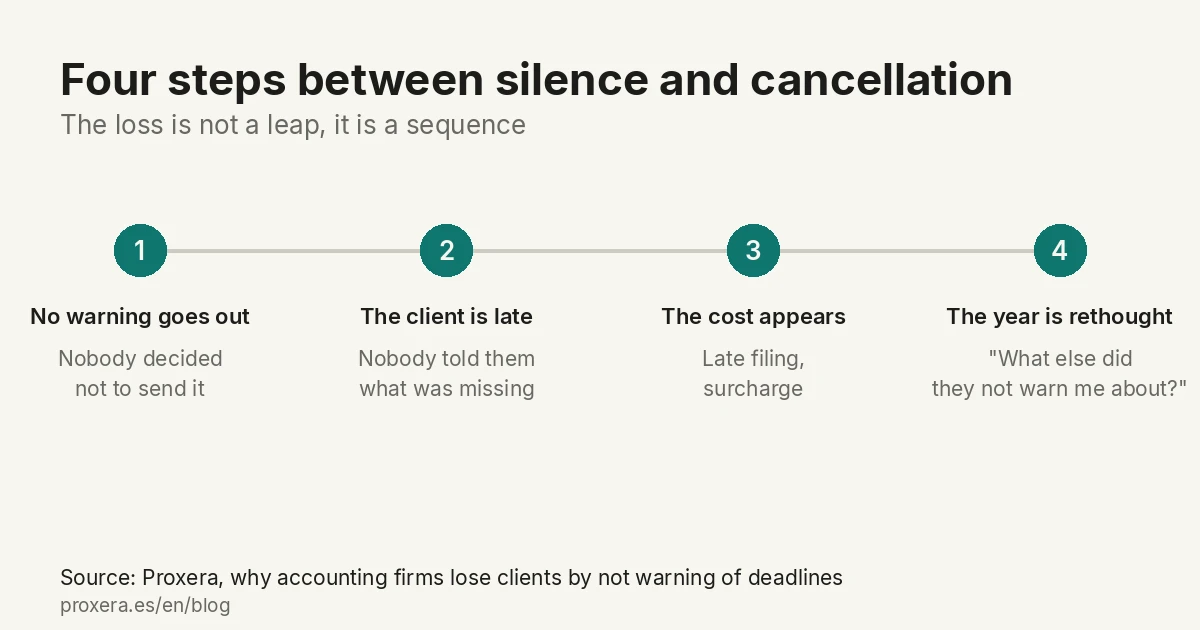
The chain: four steps between silence and cancellation
The loss is not a leap, it is a sequence. And each step has a cut-off point where it can still be stopped.
- The warning does not go out. Nobody decided not to send it. The quarterly close, two new sign-ups and an inspection simply piled up, and that particular client did not make it into the batch of emails.
- The client does not deliver on time. Not because they do not want to: because nobody told them what was missing or when. The documentation arrives on the 19th at 20:00, or it does not arrive.
- The cost appears. Filing late, a surcharge, or no filing at all. Here the client puts a price on the problem for the first time.
- The client reinterprets the whole year. This is the step that kills. All the well-done work of the previous twelve months is suddenly read in the light of the failure: "if they did not warn me about this, what else did they not warn me about?".
The cheap cut-off is at step 1. Step 4 is no longer negotiable.
The calendar to cover, client by client
Part of the problem is volume. A firm with 150 clients does not manage one calendar: it manages 150 different calendars, because not all of them file the same forms.
| Form (modelo) | What it is | When it is filed |
|---|---|---|
| 303 | Quarterly VAT | 20 Apr · 20 Jul · 20 Oct · 30 Jan |
| 130 | Instalment payment of personal income tax (direct estimation) | 20 Apr · 20 Jul · 20 Oct · 30 Jan |
| 111 | Withholdings on employment and professional income | 20 Apr · 20 Jul · 20 Oct · 20 Jan |
| 115 | Withholdings on property rental | 20 Apr · 20 Jul · 20 Oct · 20 Jan |
| 202 | Instalment payment of corporation tax | 20 Apr · 20 Oct · 20 Dec |
| 200 | Corporation tax (financial year = calendar year) | Until 25 July |
| 390 | Annual VAT summary | Until 30 January |
| 190 | Annual summary of withholdings | Until 31 January |
| 347 | Transactions with third parties above €3,005.06 | During February |
| 100 | Personal income tax return | Campaign from April to June |
Reference dates for financial years that coincide with the calendar year. The specific deadlines of each campaign are published by the AEAT every year and should be checked.
Nobody keeps all that in their head. It takes a system.
What the warning that did not go out costs
Here the figures are exact, and they are the ones that turn an oversight into an uncomfortable conversation. The surcharge regime for filing late without a prior request is in article 27 of the Ley General Tributaria (General Tax Act, 58/2003), as worded by Ley 11/2021:
| Delay | Surcharge | Late-payment interest |
|---|---|---|
| Each full month, up to 12 months | 1% per month (1%, 2%, 3%… up to 12%) | No |
| More than 12 months | 15% | Yes, from the day after the 12 months |
The surcharge allows a 25% reduction if the amount of the surcharge itself and of the debt is paid on time.
The key difference, the one the client understands at once: if the return goes out late but on one's own initiative, there is a surcharge. If it goes out late because the authorities requested it, there is a penalty.
Why the manual warning fails (even if the team is good)
None of these causes is a problem of technical competence:
- The warning competes with billable work. Reminding is a task that is not charged for and can always wait until tomorrow.
- The load is concentrated just when there is least time. The warnings are needed in the same two weeks in which the firm is closing.
- The channel is broken. The client replies on WhatsApp, the warning went out by email and the document ends up in a folder nobody looks at. That part is covered in document management in the accounting firm.
- Nobody knows who is missing. You know who has delivered. Knowing who has not delivered requires cross-checking two lists by hand.
- There is no second attempt. The first warning is sent. The second is often skipped.
How to tell whether your firm has this problem
Five questions. You do not have to answer them in writing or show them to anyone; it is enough to answer them honestly.
If this is your case: Xera for accountancy firms (ES) →
- In the last quarter, how many clients called you first to ask about a deadline, instead of receiving your warning?
- Without opening anything, right now: could you say which clients have something due next week?
- If the person in charge at the firm fell ill for two weeks in the middle of the campaign, would the warnings still go out?
- If tomorrow a client claims you did not warn them, can you prove otherwise in less than five minutes?
- Of your oldest clients —the ones who never ask anything— when was the last time they received something from you that was not an invoice?
If three of the five made you stop and think, the problem is not one of effort: it is how the warning is set up.
Manual warning versus automated warning
| Manual | Automated | |
|---|---|---|
| When it goes out | When someone remembers | Fixed date per form and client, prepared by the system and approved by a person |
| Coverage | The clients who were on the list | All those who have that form assigned |
| Persistence | One warning, sometimes | Scheduled cadence with reminder and final warning, approved by the team |
| Channel | Whatever the sender uses | The one the client uses (email; WhatsApp where the firm has it set up) |
| Who is missing | Found out by cross-checking lists | Listed by the system |
| Trace | The email thread of whoever sent it | Record per client and per deadline |
The last row is the one that matters the day there is a dispute: being able to prove that the warning went out, when and through which channel, completely changes the conversation.
How to automate it in five steps
- Assign forms to clients, not to folders. Each client has their list of obligations. Without that map there is no possible automation, only mass mailings.
- Set the cadence in advance. A pattern: a warning 15 days before with what is needed, a reminder 7 days before only to whoever has not delivered, a final warning 3 days before, and an internal alert to the adviser 2 days before with the list of pending items.
- Send through the client's channel. If they reply by email, the warning goes by email. A warning on a channel they do not read is a warning that did not go out. If the channel is WhatsApp, messages sent by the firm need templates approved by Meta; how that part is set up is in WhatsApp Business API for accounting firms.
- Close the loop with receipt. The warning has to switch itself off when the document comes in. Otherwise the client who has already delivered gets the reminder and the system loses credibility at once.
- Leave a trace. Date, channel, content and reply, per client and per deadline.
What should not be automated
The warning, yes (the team approves it before it goes out). Judgement, no. A client who replies to the reminder with "it is just that this quarter I invoiced something odd" does not need another reminder: they need the adviser. The system has to recognise that case and escalate it with the context already summarised, not keep insisting with the template.
That is the boundary between an automatic reminder and an operational layer that understands the replies it receives. It is covered in automate your accounting firm in 2026.
Frequently asked questions
Is the firm liable if the client files late?
It depends on what was agreed in the engagement letter (hoja de encargo). But contractual liability and the client's perception are different things: even if the firm is not legally liable, the client attributes the failure to whoever they believed was covering them. The cancellation happens all the same.
How much does it cost to file a form late?
Without a prior request, 1% for each full month of delay up to 12%, and 15% plus late-payment interest from twelve months on (art. 27 LGT), with a 25% reduction for prompt payment. With a prior request it is no longer a surcharge, it is a penalty.
Is a shared tax calendar enough?
It helps the firm to know the dates, but not the client to act. The calendar informs; the personalised, targeted warning with scheduled persistence is what produces delivery.
In summary
Tax deadlines are not missed for lack of technical knowledge: they are missed for lack of a system that warns without depending on someone remembering in the worst week of the quarter. The cost of the failure is set in the Ley General Tributaria. The cost of the client's cancellation is not.
If you want to see how it is set up on top of what you already use, without changing your tax software: automation software for accounting firms.
AI in action
Want to see XERA in action?
Talk directly to XERA and find out how it can automate the repetitive tasks in your business.
No commitment
Prefer it with a fixed day and time?
Book a video call (in Spanish)Pick a slot and the invitation reaches you straight away. The booking page is in Spanish.
Related content
Automate Your Accounting Firm in 2026: A Practical Guide for Professional Practices
A practical guide to automating your accounting and tax advisory firm or professional practice in 2026. What to automate, where to start and how XERA can help without changing your tax software.
2026 Personal Income Tax (IRPF) Checklist for Accounting Firms: Calendar, Documentation and Errors That Cost Penalties
A 2026 IRPF checklist for accounting firms: the tasks before, during and after the campaign. Avoid the chaos of April to June.