2026 Personal Income Tax (IRPF) Checklist for Accounting Firms: Calendar, Documentation and Errors That Cost Penalties
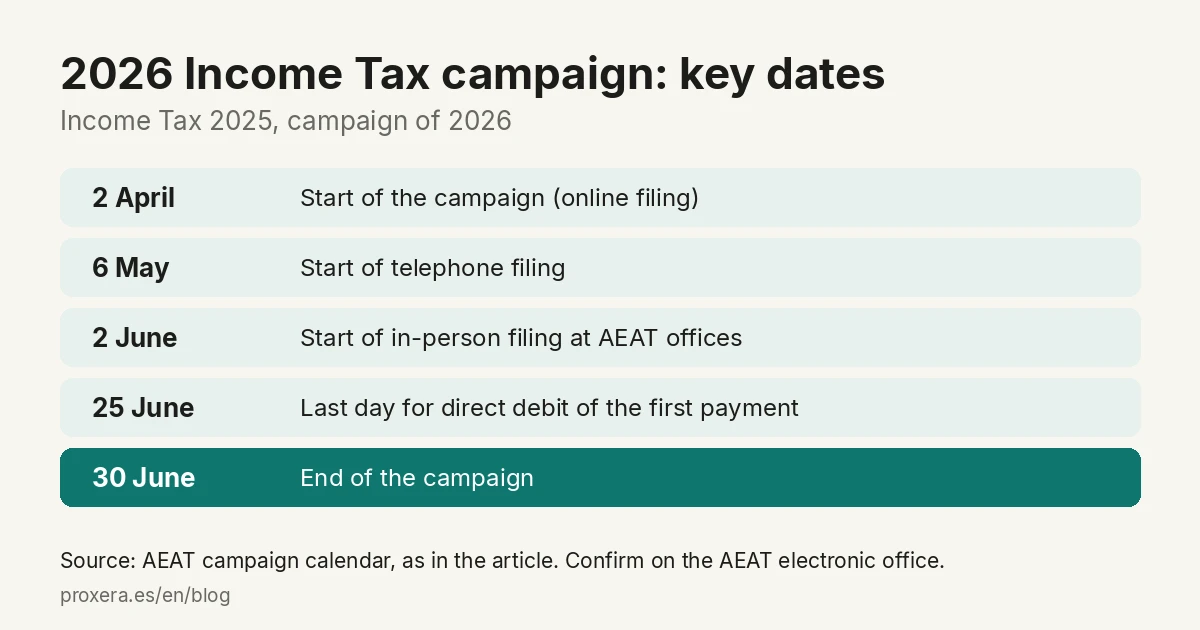
The 2026 Income Tax Campaign (for the 2025 tax year) starts on 2 April 2026 and closes on 30 June 2026. For an accounting firm, those are 90 days in which the biggest operational risk of the year is concentrated.
This checklist is designed for firms that want to get through the campaign without surprises: with the documentation collected in time and without chasing clients 48 hours before the close.
It is not a tax manual. It is the operational roadmap of the three blocks that set the result of the campaign: preparation, execution and close.
The official AEAT calendar you must have fixed
Before organising anything internally, it is worth having the dates set by the Tax Agency in view. They are the real constraints of the campaign.
Key dates Income Tax 2025 (2026 campaign)
| Milestone | Date |
|---|---|
| Start of campaign (online filing) | 2 April 2026 |
| Start of telephone filing | 6 May 2026 |
| Start of in-person filing at AEAT offices | 2 June 2026 |
| Last day for direct debit of the first payment | 25 June 2026 |
| End of campaign | 30 June 2026 |
To confirm dates and annual changes, the official reference is the AEAT electronic office.
Related forms that coexist with the campaign
While your team is on IRPF, the quarterly obligations of self-employed and company clients also fall due. It is worth keeping this in mind so as not to overload the first half of April:
- Form (modelo) 130 / 131 (instalment payment of IRPF for the self-employed): until 20 April.
- Form 303 (quarterly VAT): until 20 April.
- Form 111 (withholdings on professionals): until 20 April.
Realistic planning for April allows for two peaks: the close of first-quarter obligations (week of 14-20 April) and the full start of IRPF in parallel.
Phase 1 — Preparation (February to March)
The difference between an orderly campaign and a chaotic one is almost always decided before April. These are the four actions that make the difference.
1.1 Segment the client portfolio by tax profile
Not all IRPF clients require the same work. A useful segmentation for an accounting firm:
- Profile A — Employment income only: a single payslip, no complex deductions. Average handling time: low.
- Profile B — Employment income + regional / housing deductions: requires additional documentation. Average time: medium.
- Profile C — Self-employed under direct estimation or modules: requires books, quarterly forms and reconciliation. Average time: high.
- Profile D — Investment income / property income / crypto-assets / income abroad: requires case-by-case validation. Average time: high and erratic.
Estimating the weight of each profile in your portfolio lets you size the campaign realistically: how many team hours you need and when to open documentation requests.
1.2 Communicate the campaign to clients in advance
A communication sent in February (before the client hears about it in the press) has three effects:
- It reduces the noise of the first month of the campaign (the client who asks "has the tax thing started yet?").
- It lets the client start collecting documentation without pressure.
- It positions the firm as proactive, not reactive.
The minimum content of that communication should include: official dates, what changes from the previous year, what documentation is going to be requested, and how to deliver it. If the team manages several hundred clients, this manual sending consumes hours. It is one of the processes that can be prepared with templates and personalised sending, for a person to approve before it goes out.
1.3 Prepare the documentation request templates
For each client profile, define before March the exact list of documents you are going to request. Typical templates:
Profile A (employment income):
- Withholding certificate from the payer
- Proof of contributions to pension plans
- Proof of applicable regional deductions
- Information on changes in family situation
Profile B (with housing):
- Everything above
- Mortgage receipts (if the acquisition was before 2013, the state deduction in force)
- Rent receipts (regional deduction depending on the region)
- Certificate of interest from the bank
Profile C (self-employed):
- Income and expense books for the year
- Forms filed during the year (130 / 131 / 303) and the annual VAT summary (390)
- Proof of deductible expenses
- Certificates of withholdings received (111) and borne
Profile D (capital and complex income):
- Consolidated position of accounts and securities
- Purchase-sale transactions with exact dates
- In the case of crypto-assets: history of transactions (the reporting obligation exists since the 2023 tax year)
- Form 720 / 721 if applicable
1.4 Audit the tax data in your system
Before starting, it is worth checking that each client's record has up-to-date data: tax address, marital status, dependent descendants, IBAN for refund or payment. An error in any of these fields can invalidate the filing or delay the refund by months.
Phase 2 — Execution (April to June)
Once the campaign starts, the team goes into production mode. What makes the difference here is operational discipline, not one-off speed.
2.1 Prioritisation system by urgency
Not all case files carry the same risk. A useful three-level classification:
- P0 — Urgent (resolve in less than 7 days): clients with a high amount to pay (better to file early in order to set up the direct debit), clients asking for the status of the procedure, cases with a previous incident with the AEAT.
- P1 — Important (resolve in 7-15 days): complete documentation, medium-complexity profile, no specific urgency from the client.
- P2 — Standard (resolve in 15-30 days): simple employment income, expected refund, documentation available.
The operating rule: in April, P0 and P1 are worked first. From 1 June, only pending case files with an amount to pay are prioritised (refund ones can be filed until 30 June without surcharge).
If this is your case: Xera for accountancy firms (ES) →
2.2 The queries that repeat every year
A good part of the team's time is spent answering the same questions. Having a base of standard answers ready reduces that load:
- When will I receive my refund? The AEAT legal period is 6 months from the end of the campaign.
- Can I deduct teleworking expenses? Only specific, justifiable expenses (it is not a generic deduction).
- Do I have to declare crypto-assets? Yes, there has been a reporting obligation since 2023. Sales at a profit are taxed as a capital gain.
- What happens if I do not file on time? A surcharge applies, and it grows the later you file.
- Can I defer the payment? Yes. Deferral or instalment requests managed by the AEAT are exempt from guarantees up to €50,000 in total (Orden HFP/311/2023). In addition, the payment of the return can be split, without interest or surcharge, into two payments: 60% when you file and the remaining 40% within the period set by the order for the campaign (Reglamento del IRPF, art. 62.2). Debts that include withholdings or output VAT cannot be deferred (LGT, art. 65.2).
2.3 Proactive communication during the campaign
A regular update on the status of each client's case file (prepared automatically, approved by the team) keeps clients informed without interrupting the adviser with status questions.
2.4 Validation before filing
Each filing should go through a minimum checklist:
- Correct IBAN (for refund or payment)
- Up-to-date personal data
- Critical boxes reviewed (regional deductions, personal allowance for descendants, housing)
- Direct debit handled before 25 June if there is an amount to pay
- Receipt signed by the client or electronic validation
Phase 3 — Close (July onwards)
Three actions that are not urgent but make a difference to the firm's annual result.
3.1 Archiving and retention
The Administration's right to assess and demand payment expires after four years (LGT, art. 66), counted from the day after the end of the filing period. It is advisable to keep the documentation at least that long; for accounting books or investment assets the periods may be longer. In practice, archiving every closed case file digitally (return filed, proof, communications with the client) is the only realistic way to have it at hand.
A document management system that classifies the documents when the case file is closed can save much of the archiving work at the end of the summer.
3.2 Internal review of errors and improvements
In the first half of July, before the team disconnects, a short retrospective is worth doing:
- How many returns were filed late (even by a day)?
- What type of errors were repeated and why?
- Which clients generated the most friction and how could it be prevented next year?
- Which processes were done by hand that could be automated for 2027?
3.3 Closing communication to the client
A brief email confirming that the case file is closed, the status of the refund or payment, and thanking them for their collaboration closes the cycle. It is one of the communications with the greatest impact on the perception of service and is usually used to detect upsell opportunities (tax planning, inheritances, next year's returns).
The 5 errors that usually end in a penalty
These are common errors:
- Forgetting to declare income abroad (bank accounts, pension plans, rentals) when it exceeds the thresholds of forms 720 / 721.
- Not declaring transactions with crypto-assets, even losses. The reporting obligation is independent of the result.
- Applying regional deductions without proof. Each Autonomous Community has its own regime.
- Confusing the personal allowance for descendants with the large-family deduction. They are different figures and are applied in different boxes.
- Filing without direct debit when there is an amount to pay. If 25 June passes without direct debit, it has to be paid manually before 30 June or it is considered late.
Each of these errors can be put right by a supplementary return, but it involves a surcharge that grows with the delay and, in cases detected by the AEAT in an inspection, penalties of 50% to 150% of the tax due.
The invisible factor: what is lost to manual processes
AEAT deadlines are inflexible. What usually fails in a campaign are the intermediate processes: collecting documentation, replies to repetitive queries, updating the client on the status of the case file, the later archiving.
These tasks do not require tax knowledge, but they consume much of the team's time during the 90 most critical days of the year.
XERA is the operational AI layer that runs on top of the tax software you already use, without migrating anything (if your software has an API, we connect it), and helps with precisely those processes: collecting documentation, preparing replies to clients for the team to approve, follow-up of case files and archiving of documents.
If your firm is going to enter another Income Tax campaign without having reviewed these processes, it is worth at least calculating the real cost of doing everything by hand one more year.
→ Request a demo and we will show you which parts of the campaign can be automated before April 2027. Demos are held in Spanish.
Related articles
- Documentation for the 2026 income tax: how your firm can collect it without calls or emails (ES)
- AI automation for accounting firms during the 2026 income tax campaign (ES)
- Software for Tax Accounting Firms 2026: Which Functions Cannot Be Missing
- XERA for accounting firms: what it automates and how it fits your firm
AI in action
Want to see XERA in action?
Talk directly to XERA and find out how it can automate the repetitive tasks in your business.
No commitment
Prefer it with a fixed day and time?
Book a video call (in Spanish)Pick a slot and the invitation reaches you straight away. The booking page is in Spanish.