5,033 revoked tax IDs in one BOE: what happens to a company and how its accounting firm sees it
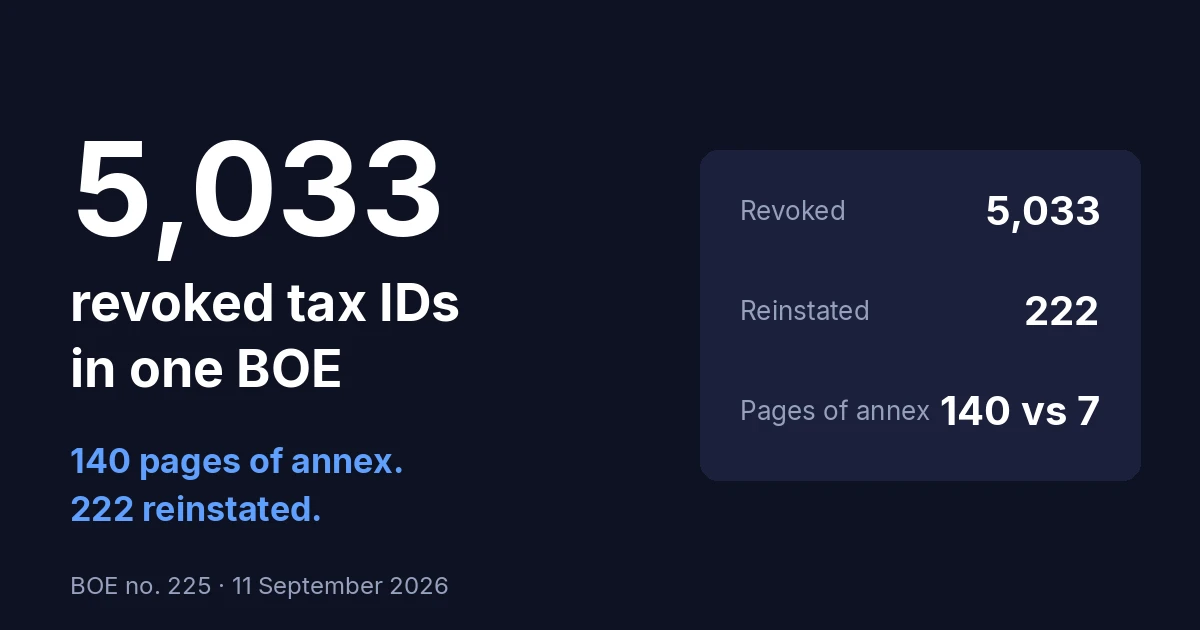
The BOE of 11 September 2026 published two resolutions of the Tax Agency (Agencia Tributaria), both signed on the 8th by the Director of the Tax Management Department.
In one, 5,033 revoked tax identification numbers (NIF). In the other, 222 reinstated.
One hundred and forty pages of annex against seven. Almost twenty-three times more companies losing their NIF than recovering it, in a single batch and on an ordinary Friday.
This article explains what that really means, with the rule next to each statement. And it starts by dismantling what is repeated most about the subject, which is false.
No, it is not because of owing money to the Tax Agency
It is the first thing that comes up when you search for it, and it is not in the rule.
There are seven grounds for revocation and they are exhaustive: they are in article 147.1 of Real Decreto 1065/2007 (the general regulation on tax management and inspection). None of them is, by itself, owing money to the Tax Agency:
| Ground, according to the regulation | |
|---|---|
| a) | Not providing the documentation to move from a provisional to a definitive NIF; the cases of article 119 of the Corporate Income Tax Act; or that for more than a year, and after at least three attempts, it has been impossible to notify at the registered tax address, or debts have been written off for insolvency over three periods |
| b) | Having reported to the Administration the carrying on of non-existent economic activities |
| c) | A company set up that within three months does not start its activity or preparatory acts, without justifying why |
| d) | The same capital having been used to set up several companies, without the minimum payment required |
| e) | Declaring the activity or the management of the business at an apparent or false address |
| f) | Failing for four consecutive financial years to file the annual accounts with the Commercial Registry |
| g) | Precautionary deregistration of digital platform operators that do not provide information after two requests |
The closest to a debt —letter a), by reference to article 146.1.d)— speaks of debts that the Administration has written off for insolvency over three periods, or of more than a year of impossible notifications. That is not the same as having an outstanding debt.
Look at letter f) carefully, because it is the one most like an accounting firm's day to day: four years without filing accounts with the Commercial Registry. That is not sophisticated fraud. It is a company that stood still and that nobody looked after.
What really happens to a company with a revoked NIF
1. The bank stops moving the account, and not only for the holder
Once the revocation is published in the BOE, credit institutions cannot make debits or credits on accounts where the revoked NIF appears as holder or as authorised person. No collections, no payments, no direct debits. And it is not lifted until the NIF is reinstated.
«la publicación anterior determinará que las entidades de crédito no realicen cargos o abonos en las cuentas o depósitos bancarios en que consten como titulares o autorizados los titulares de dichos números revocados, salvo que se rehabilite el número de identificación fiscal»
— Ley 58/2003 General Tributaria, disposición adicional sexta, apartado 4
The detail of "or authorised persons" is the one that is almost always missed: the rule also reaches accounts held by others in which the person or entity with the revoked NIF appears only as an authorised person.
2. The company is closed off before a notary and any registry
When the revoked NIF belongs to an entity, the notary must abstain from authorising any public instrument —contracts, agreements, any legal transaction— and access to any public registry is prohibited, including administrative ones. Not just the Commercial Registry.
The registry where it is entered also makes a marginal note on its sheet warning that nothing more can be entered, and that note appears on all the certificates requested for the company. The only exception allowed is processing the cancellation of that same note.
(Same additional provision six, section 4, third, fourth and fifth paragraphs.)
3. The debts do not disappear; the way of settling them does
The revocation extinguishes nothing. The Administration can still demand the outstanding tax obligations. And at the same time, the admission of self-assessments, returns, communications or documents filed with that NIF is conditional on reinstating it first. You still owe, and the procedure is closed as well.
If this is your case: Xera for accountancy firms (ES) →
4. The certificate of being up to date, the ROI and the REDEME fall
With a revoked NIF the certificate of being up to date with tax obligations is not issued. Under other rules, someone who is not up to date with their tax obligations cannot obtain grants (Ley 38/2003, art. 13.2.e) or contract with the public sector (Ley 9/2017, art. 71.1.d). And the company is deregistered from the Register of Intra-Community Operators (ROI), from the monthly VAT refund register (REDEME) and from the territorial registers of Excise Duties and fluorinated gases.
(Article 147, sections 5 and 7, of Real Decreto 1065/2007.)
The Tax Agency does notify. The question is whom
Here it is worth being precise, because the opposite circulates.
It is not true that the BOE is the first notice. The revocation decision requires a prior hearing of the taxpayer for 10 days (unless the decision is already included in the resolution proposal), and the revocation must be published in the BOE and notified to the person concerned. Both things, not one.
«El acuerdo de revocación requerirá la previa audiencia al obligado tributario por un plazo de 10 días […] salvo que dicho acuerdo se incluya en la propuesta de resolución a que se refiere el artículo 145.3»
— Artículo 147.2 del RD 1065/2007
Whether that notification arrives is another matter. One of the grounds for revocation is, precisely, that it has been impossible to notify for more than a year at the registered tax address: there are companies that find out through the BOE because there was no way of locating them before.
And there is a third party that nobody notifies: their accounting firm. The list is published, and that is all. If a client of yours appears in those 140 pages, you are not going to receive any email telling you.
How it is reinstated
It can be done. It is regulated by article 147.8 of the same regulation, and it has more small print than it seems:
- Only applications that prove that the grounds that led to the revocation have disappeared are processed.
- If it is a company, you must also report who holds the capital, its legal representatives, the beneficial owners under Ley 10/2010 on money laundering, the registered tax address and documentation of the activity it is going to carry on.
- Without those requirements, the application is closed without further processing.
- If the ground was not filing accounts, they must be filed first.
- The period for a decision is three months and silence means refusal: once that period has passed without a reply, it is understood to be denied.
What an accounting firm can do about it
The Tax Agency publishes these resolutions regularly, and as a rule they come out on Mondays, Wednesdays and Fridays —article 147.3 refers to the calendar of notifications by appearance in the General Tax Act.
So it is not an event: it is a trickle. The operational question for a firm is simple to state and heavy to carry out:
Is any of my clients on today's list?
Cross-checking 140 pages of annex against a portfolio of two hundred clients is not difficult; it is repetitive, silent and with no notice date. And the day one is missed, the firm does not have the problem: the client does, with their bank frozen.
That is exactly the kind of task that is best not to depend on someone remembering.
Sources
Everything quoted in this article comes from consolidated legal text and from the BOE itself, consulted on 12 September 2026:
- Ley 58/2003, de 17 de diciembre, General Tributaria, additional provision six, section 4 (consolidated text).
- Real Decreto 1065/2007, general regulation on tax management and inspection, article 147 (consolidated text).
- BOE-A-2026-19038, revocation of NIFs, «BOE» núm. 225 de 11-09-2026, pp. 121394-121533 (document).
- BOE-A-2026-19037, reinstatement of NIFs, same date and signature, pp. 121387-121393 (document).
The figures of 5,033 and 222 are entries in the annex of each resolution, counted on the published text. We do not point to any specific company.
AI in action
Want to see XERA in action?
Talk directly to XERA and find out how it can automate the repetitive tasks in your business.
No commitment
Prefer it with a fixed day and time?
Book a video call (in Spanish)Pick a slot and the invitation reaches you straight away. The booking page is in Spanish.
Related content
Automate Your Accounting Firm in 2026: A Practical Guide for Professional Practices
A practical guide to automating your accounting and tax advisory firm or professional practice in 2026. What to automate, where to start and how XERA can help without changing your tax software.
2026 Personal Income Tax (IRPF) Checklist for Accounting Firms: Calendar, Documentation and Errors That Cost Penalties
A 2026 IRPF checklist for accounting firms: the tasks before, during and after the campaign. Avoid the chaos of April to June.