The Supreme Court annuls article 197.2 of the immigration regulation: what the two rulings say
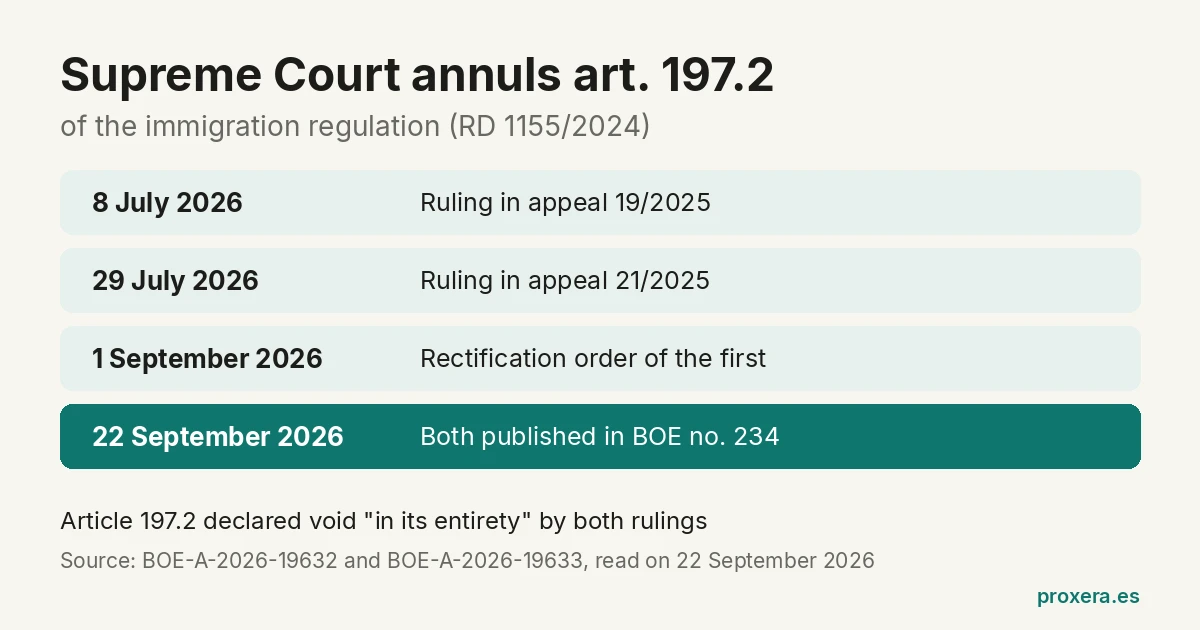
BOE no. 234, of 22 September 2026, publishes two rulings of the Third Chamber of the Supreme Court against Real Decreto 1155/2024, de 19 de noviembre, the one that approves the Regulation of Ley Orgánica 4/2000 (the immigration regulation).
Both declare article 197.2 void "in its entirety". The first also annuls nine more provisions or phrases of the same regulation.
No new royal decree comes out. The regulation changes by court ruling, and that is published in section I of the BOE with the Supreme Court as the department.
How this is written. It is information, not legal advice. Everything we quote is copied from the two BOE documents, which we read in full on 22 September 2026. What the rulings do not say, we do not say here either. Before touching a case file, read the original: it is five pages between the two, and the links are at the end. The literal quotations are in Spanish, as published, with their reference.
Quick answer
| Question | What the BOE says |
|---|---|
| What is annulled? | Article 197.2 of RD 1155/2024 in full, and nine more provisions or phrases (BOE-A-2026-19632). |
| How many rulings are there? | Two. One of 8 July 2026 (appeal 19/2025) and another of 29 July 2026 (appeal 21/2025). |
| When were they published? | Both in BOE no. 234, of 22 September 2026. |
| Can they be appealed? | The one of 29 July says so expressly: «contra la misma no cabe recurso». The published text of the one of 8 July does not mention it. |
| Can the electronic relationship be imposed again? | The ruling leaves that door open, with conditions. It is further down, word for word. |
| What did article 197.2 regulate? | The rulings do not say. The consolidated text of RD 1155/2024 says that «tendrán obligación de relacionarse a través de los medios electrónicos habilitados las personas físicas que presenten alguno de los tipos de solicitud siguientes» (seven types, letters a to g), with the note «se declara la nulidad del apartado 2 en su integridad». |
| Since when does the nullity take effect? | The rulings do not fix a date. The law does: under article 72.2 of Ley 29/1998, final rulings that annul a general provision have general effects from the day their operative part is published in the BOE. |
The ruling of 8 July 2026 (BOE-A-2026-19632)
It resolves contentious-administrative appeal 19/2025, brought by Asociación Coordinadora de Barrios para el seguimiento de menores y jóvenes, Asociación Pro Derechos Humanos de España and Extranjeristas en Red. It upholds it in part.
It declares the nullity in full law of these provisions of RD 1155/2024:
| Provision | What it annuls, according to the ruling | |
|---|---|---|
| a) | Art. 101.1, third paragraph | The prohibition on temporary employment agencies holding residence and work authorisations for seasonal activities, or being authorised through a change of employer or in the chain of concatenated contracts. |
| b) | Art. 94.1.f) | The phrase «Esta relación deberá haber sido constituida conforme al ordenamiento jurídico español». |
| c) | Art. 196.b) | The phrase requiring that the ascendant's economic dependence «se produzca en el país de origen o de procedencia», insofar as it prevents proving it when the ascendant is already in Spain. |
| d) | Arts. 97.4 and 98.1 | The phrases establishing automatic refusal for criminal records without individualised weighing, in the cases of article 20 of the Treaty on the Functioning of the European Union. |
| e) | Art. 159.1 | The phrase «solteras» ("unmarried", feminine plural). |
| f) | Art. 160.1 | The phrase «solteros» ("unmarried", masculine plural). |
| g) | Art. 159.1 | The phrase «y no se haya ausentado del territorio nacional desde su nacimiento, en cuyo caso, resultará de aplicación lo previsto en el capítulo II del título IV», without prejudice to the Administration being able to require that the minor has had their habitual effective residence in Spain since birth, assessing temporary and justified absences. |
| h) | Art. 160.2 | The phrase «siempre y cuando esta relación haya sido constituida conforme al ordenamiento jurídico español». |
| i) | Art. 166.1, second paragraph | The phrase «en su caso». The ruling adds that the obligation of immediate care in article 35.3 of Ley Orgánica 4/2000 «opera con carácter imperativo e incondicionado» from the moment the State Security Forces report the location of a foreigner of uncertain minority. |
| j) | Art. 197.2 | In full, with the reservation about the electronic relationship quoted below. |
The rest of the ruling, in short:
- It dismisses the other claims and declares the challenged provisions that are not on the list to be in accordance with the law.
- It declares the proceedings terminated with regard to transitional provision 5 of RD 1155/2024 («derogada por el Real Decreto 316/2026», says the ruling), the phrases of articles 97.1.c) and 97.5, by withdrawal of the claimant, and article 191.7.b) as regards the authorisations of article 128.1.
- It refuses to refer a preliminary question to the Court of Justice of the European Union.
- «No hacer expresa imposición de costas» (no express order as to costs).
The rectification order of 1 September
The same BOE document includes an order of 1 September 2026 that rectifies «la sentencia núm. 868/2026, de 8 de julio». It does two things:
- It dismisses the rectification requested on the six-month period for submitting the application under article 159.1, second paragraph, because that point had already been resolved in the ruling.
- It adds to the operative part this statement, which was in the reasoning and had been omitted from the operative part:
«Se declara que la condición establecida en el artículo 159.1, párrafo segundo, del Reglamento aprobado por Real Decreto 1155/2024, de 19 de noviembre, relativa a que el menor no se haya ausentado del territorio nacional desde su nacimiento, debe interpretarse en el sentido de que el menor haya mantenido su residencia efectiva habitual en España, sin que las ausencias temporales y justificadas determinen por sí mismas la inaplicación del precepto ni la remisión automática al régimen previsto en el capítulo II del título IV del Reglamento.»
If this is your case: Xera for law firms (ES) →
The order records that the rectification «no altera, modifica ni amplía el contenido decisorio de la sentencia» (does not alter, modify or extend the operative content of the ruling).
The ruling of 29 July 2026 (BOE-A-2026-19633)
It resolves appeal 21/2025, brought by Cáritas Española, la Comisión Española de Ayuda al Refugiado, la Federación Andalucía Acoge, la Federación Red Acoge and el Servicio Jesuita a Migrantes. It is handed down by the Third Chamber, Fifth Section, and also upholds the appeal in part.
Its central point is this:
«Reiterar la declaración de nulidad de pleno Derecho del artículo 197.2 del Real Decreto 1155/2024, de 19 de noviembre, en su integridad, ya efectuada en la STS n.º 868/2026 […]»
That is, it repeats the nullity already declared by the ruling of 8 July. It dismisses the remaining claims, declares the proceedings terminated with regard to the same transitional provision 5, orders costs «conforme a lo dispuesto en el último Fundamento de esta sentencia» (in accordance with the last ground of the ruling) and is notified to the parties «haciéndoles saber que contra la misma no cabe recurso» (making them aware that it cannot be appealed).
The door they leave open: the electronic relationship
The two rulings annul 197.2 with the same reservation, word for word:
«sin perjuicio de que el titular de la potestad reglamentaria pueda establecer, en ejercicio de la habilitación del artículo 14.3 de la Ley 39/2015, de 1 de octubre, una obligación de relación electrónica para determinadas categorías de procedimientos de extranjería, siempre que cumpla con los requisitos de justificación y proporcionalidad que ese precepto y el artículo 3.2 del Real Decreto 203/2021, de 30 de marzo, imponen.»
Read as it stands: the Government can impose by regulation that certain categories of immigration procedures be handled electronically, if it justifies it and it is proportionate under those two provisions. The ruling does not say whether it will do so or when. What article 14.3 of Ley 39/2015 and 3.2 of RD 203/2021 require is not reproduced either: both are linked at the end.
What also matters: the calendar
| Date | What happens |
|---|---|
| 8 July 2026 | Ruling in appeal 19/2025 («STS n.º 868/2026») |
| 29 July 2026 | Ruling in appeal 21/2025 |
| 1 September 2026 | Rectification order of the one of 8 July |
| 22 September 2026 | Both are published in BOE no. 234 |
Between the first ruling and its publication in the BOE there are 76 calendar days. Between the second and its publication, 55.
Both rulings order that they be notified to the parties. When they were notified does not appear in the BOE. What is certain is that a firm that handles immigration work and was not a party to either appeal is not a recipient of that notification. Its public reference is the BOE of 22 September.
And what has changed is the regulation it works with every day, without a new rule having come out with its title and its date of entry into force. A ruling comes out in section I, among the rest of the day's provisions.
So the practical question is not legal. It is one of internal procedure: if you handle immigration work, how would you have found out about this? Through your management software, a newsletter, a colleague, or a client on the phone?
It is not the first time the BOE has brought something that affects a firm's clients without anyone warning the firm. We told it with the Tax Agency's revoked NIFs in 5,033 revoked tax IDs in one BOE.
Sources
Consulted on 22 September 2026:
- BOE-A-2026-19632. Ruling of 8 July 2026 of the Third Chamber of the Supreme Court (appeal 19/2025) and rectification order of 1 September 2026. «BOE» núm. 234, de 22 de septiembre de 2026, pp. 124798 to 124800 (document).
- BOE-A-2026-19633. Ruling of 29 July 2026 of the Third Chamber of the Supreme Court (appeal 21/2025). «BOE» núm. 234, de 22 de septiembre de 2026, pp. 124801 to 124802 (document).
- Real Decreto 1155/2024, of 19 November, text published in «BOE» núm. 280, de 20 de noviembre de 2024 (document).
- Ley 39/2015, of 1 October, on the Common Administrative Procedure (document).
- Real Decreto 203/2021, of 30 March, Regulation on the operation of the public sector by electronic means (document).
- Ley 29/1998, of 13 July, regulating the Contentious-Administrative Jurisdiction (document).
AI in action
Want to see XERA in action?
Talk directly to XERA and find out how it can automate the repetitive tasks in your business.
No commitment
Prefer it with a fixed day and time?
Book a video call (in Spanish)Pick a slot and the invitation reaches you straight away. The booking page is in Spanish.
Related content
Automate Your Accounting Firm in 2026: A Practical Guide for Professional Practices
A practical guide to automating your accounting and tax advisory firm or professional practice in 2026. What to automate, where to start and how XERA can help without changing your tax software.
2026 Personal Income Tax (IRPF) Checklist for Accounting Firms: Calendar, Documentation and Errors That Cost Penalties
A 2026 IRPF checklist for accounting firms: the tasks before, during and after the campaign. Avoid the chaos of April to June.