CRM for lawyers: what it is, what it has to do and how to choose one
How this article was written. It is a guide, not a comparison: we do not rank products or give third-party prices, which change. The obligations we cite come from the General Statute of the Spanish Legal Profession (Estatuto General de la Abogacía Española, Real Decreto 135/2021) and from the General Data Protection Regulation (GDPR), in the text published on boe.es and read on 2 October 2026. Literal quotations are in Spanish, the language of the official text. This is information, not legal advice. Proxera sells XERA, an AI assistant for law firms: we say so up front, so that you can take it into account as you read.
What a CRM for lawyers is
A CRM for lawyers is the software where a law firm records every person who contacts it and what happens with them: how they arrived, what they asked about, whether they were sent the engagement letter (hoja de encargo), whether they signed it and when to speak to them again. Its purpose is the relationship with the client, before, during and after the matter. The case file, the procedural deadlines and the briefs are handled by another program: the firm's practice-management software.
CRM and practice-management software: how they differ
| CRM | Practice-management software | |
|---|---|---|
| Question it answers | Who are we talking to and where is each relationship? | What state is each matter in? |
| Unit of work | The person or company: prospect, client, former client | The case file |
| When it starts | With the first enquiry, before there is a matter | When the engagement is accepted |
| What it stores | Source of the contact, enquiries, quotes, engagement letters sent and signed, next contact | Actions taken, procedural deadlines, briefs, documents, billing per matter |
| What is lost without it | Enquiries left unanswered, quotes with no follow-up, former clients nobody calls again | The matter's deadlines and documents |
Some practice-management programs have a client module, and some CRMs have something like case files. The boundary is not set by the name of the product but by the question it answers. If what you are looking for is the program for case files, deadlines and documents, we cover it separately in what practice-management software for law firms has to solve (ES).
What a CRM has to do in a law firm
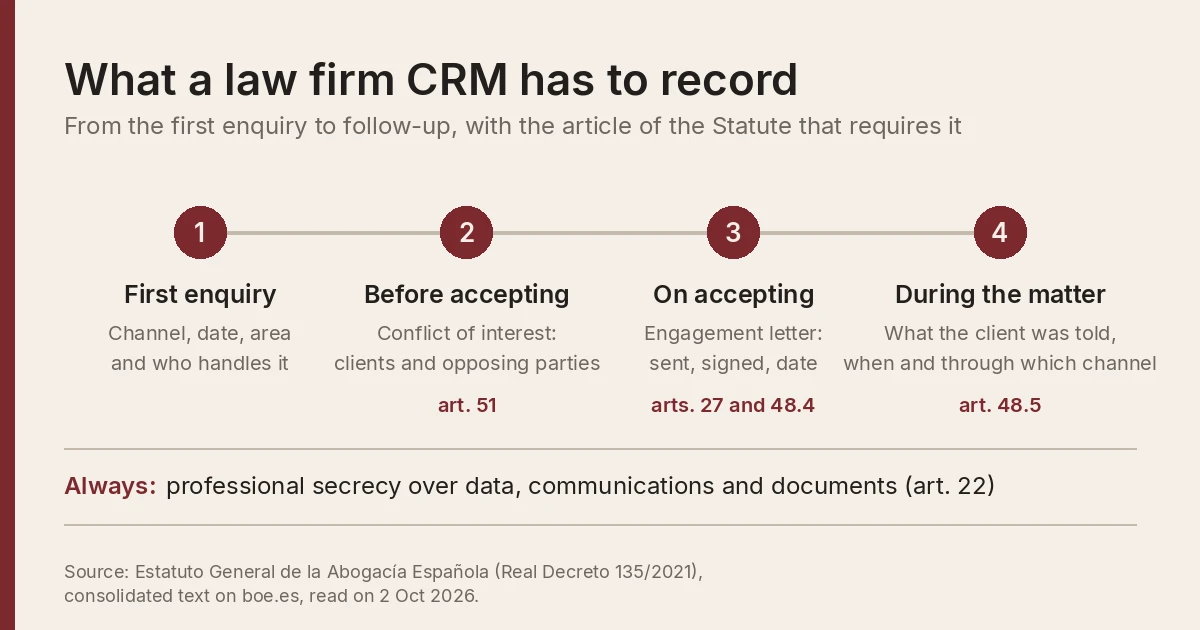
A generic CRM tracks sales opportunities. In a law firm, the path of an enquiry goes through obligations set by the General Statute of the Spanish Legal Profession, and the CRM has to leave a trace of each one.
| Moment | What the Statute asks | What the CRM has to record |
|---|---|---|
| First enquiry | — | Channel, date, area and who in the firm handles it |
| Before accepting | Not to defend conflicting interests (art. 51) | Clients, former clients and opposing parties, in one place and searchable |
| On accepting | To inform before starting, preferably with an engagement letter (arts. 27 and 48.4) | Status of the engagement letter: prepared, sent, signed, and the date |
| During the matter | To inform the client of the state of the matter and of relevant incidents and rulings (art. 48.5) | What the client was told, when and through which channel |
| Always | Professional secrecy over all data, communications and documents of the practice (art. 22) | Who can see each record |
1. Capture the first enquiry, however it arrives
Phone, website form, email, WhatsApp or a recommendation. If each channel ends up in a different place, the enquiry that came in on Friday afternoon is seen by nobody on Monday. The minimum is one record per person with the channel, the date, the area (employment, family, commercial…) and who in the firm handles it.
2. Help check for conflicts of interest before accepting
Article 51 of the Statute requires a lawyer not to defend interests in conflict with those of the client, and to refrain from acting for a new client when there is a risk of breaching professional secrecy about what a former client told them (art. 51.4). To check this, you need to search clients, former clients and opposing parties in one place. A CRM that only stores "clients" does not store the opposing party: ask whether it can be recorded and searched.
3. Manage the engagement letter
Before starting, the lawyer has to inform the client of what article 48 sets out, «preferentemente mediante la utilización de hojas de encargo» (art. 27), that is, preferably by using engagement letters. That information includes fees and costs and the consequences an order to pay costs may have (art. 48.4). The CRM does not draft the letter, but it does have to show the whole firm what state it is in: prepared, sent or signed.
4. Run the two follow-ups
They are different and are best not mixed:
- The follow-up of someone who is not yet a client: a quote sent and unanswered, who calls again and when.
- The follow-up of someone who already is: article 48.5 requires the client to be informed of the state of their matter. The CRM records what they were told and when; the procedural status comes from the practice-management software. That is why it helps for the two programs to talk to each other.
5. Do not lose former clients
When a matter is closed, the record stays: in which area they were served and when. If you want to write to them again for commercial purposes, that has its own rules on data protection and commercial communications: make sure the CRM records what each person has consented to.
Three routes: a general-purpose CRM, a CRM for law firms, or the module in your software
There is no order from better to worse. It depends on how the firm works.
If this is your case: Xera for law firms (ES) →
| Route | In favour | Against | Fits if… |
|---|---|---|---|
| General-purpose CRM (sales, any sector) | Designed to track opportunities; adapts with your own fields and stages | What is specific to a law firm (opposing party, engagement letter, area) has to be checked for or built by hand | You mainly want to look after client acquisition and someone in the firm will configure it |
| CRM designed for law firms | Starts from the firm's vocabulary: matters, parties, engagements | If it was built for another country, check that it fits the Statute, the language and where the data is hosted | You want something made for law firms from day one and are willing to change tools |
| Client module of your practice-management software | One program: client and case file together | May fall short on the commercial side: enquiries that never become a matter, quotes without a reply | Almost everything that comes in ends up as a matter and there is little commercial follow-up |
What to ask before choosing
- Who is going to fill it in, and when? An empty CRM is of no use. Decide who records each enquiry and at what point before looking at products.
- Who at the provider can see your data? Professional secrecy covers «todos los hechos, comunicaciones, datos, informaciones, documentos y propuestas» of the practice (art. 22.1), and the lawyer must also have it respected by those who cooperate with them in their professional activity (art. 22.4). Ask who at the provider accesses the information and in which cases.
- Is there a data processing agreement? The provider processes data on the firm's behalf, and that requires a contract setting out the subject matter, duration, purpose, type of data and the firm's obligations and rights (GDPR art. 28.3). In addition, it cannot engage another processor without the firm's prior written authorisation (art. 28.2): ask for the list of sub-processors.
- Where is the data hosted? If it is sent to a "third country", as the GDPR calls it, the international-transfer rules of its chapter V apply (art. 44 onwards). Ask for the country of hosting and that of each sub-processor.
- Does it connect with what you already use? Email, calendar, practice-management software, electronic signature. Ask whether it has an API: without one, every item of data is copied by hand.
- Can the data be taken out? A full export, in a format that can be opened with another program, in case you change one day.
- Does it record the opposing party and can it be searched? It is what you need for the conflict of interest.
- Does it record calls? If it does, the Statute only allows recording a lawyer's conversations with clients, opposing parties or their lawyers «con la previa advertencia y conformidad de todos los intervinientes» (art. 22.3), that is, with prior warning and the agreement of everyone taking part.
Where AI comes in, and where it does not
A CRM stores and organises, but somebody has to record and reply. That is where AI helps: reading what comes in, summarising it, preparing the record and the draft. What it does not do is decide whether there is a conflict of interest, accept an engagement or give advice. That belongs to the lawyer.
XERA, our assistant for law firms, reads the court notifications that reach your email, summarises them and warns of the deadline (it warns; it is not a substitute for your own deadline control); searches for documents in your email and shared drive, if your tools have an API; and prepares drafts of engagement letters and client communications with the case file data. Critical actions, such as sending a brief or notifying the client, need the lawyer's OK. With every client we sign the data processing agreement under article 28 of the GDPR.
XERA does not replace the CRM. If your CRM or your tool has an API, we connect it. What it does in a law firm, in detail: XERA for law firms. How enquiries are answered and followed up with AI: how law firms use AI so they do not lose clients (ES). And what it costs: XERA plans and prices.
Frequently asked questions
Does a CRM for lawyers replace the firm's practice-management software?
No. The CRM handles the relationship with the person, from the first enquiry. The practice-management software handles the case file: actions, deadlines and documents. They can coexist and, better still, be connected.
Does a small law firm need a CRM?
It needs a single place where every enquiry, the state of the engagement letter and the next contact are recorded, and where opposing parties can be searched. If a tool you already use does that, with the data guarantees in the list above, it may be enough to start with.
Can the CRM provider see our clients' data?
It depends on the provider and on what you sign. The data processing agreement (GDPR art. 28) sets what it may process the data for and with which other processors. Ask for it before entering a single item of data.
Does a CRM warn of procedural deadlines?
A CRM can remind you of dated tasks, but a procedural deadline arises from a notification and belongs to the case file. It makes sense for the practice-management software, or an assistant that reads notifications, to handle it, and for the CRM to reflect only what affects the relationship with the client.
Legal texts consulted on boe.es on 2 October 2026: General Statute of the Spanish Legal Profession (Estatuto General de la Abogacía Española), consolidated text and Regulation (EU) 2016/679, GDPR.
AI in action
Want to see XERA in action?
Talk directly to XERA and find out how it can automate the repetitive tasks in your business.
No commitment
Prefer it with a fixed day and time?
Book a video call (in Spanish)Pick a slot and the invitation reaches you straight away. The booking page is in Spanish.
Related content
Automate Your Accounting Firm in 2026: A Practical Guide for Professional Practices
A practical guide to automating your accounting and tax advisory firm or professional practice in 2026. What to automate, where to start and how XERA can help without changing your tax software.
2026 Personal Income Tax (IRPF) Checklist for Accounting Firms: Calendar, Documentation and Errors That Cost Penalties
A 2026 IRPF checklist for accounting firms: the tasks before, during and after the campaign. Avoid the chaos of April to June.