We moved our voice assistant to Eleven v4 Turbo: what changes and which technology it runs on
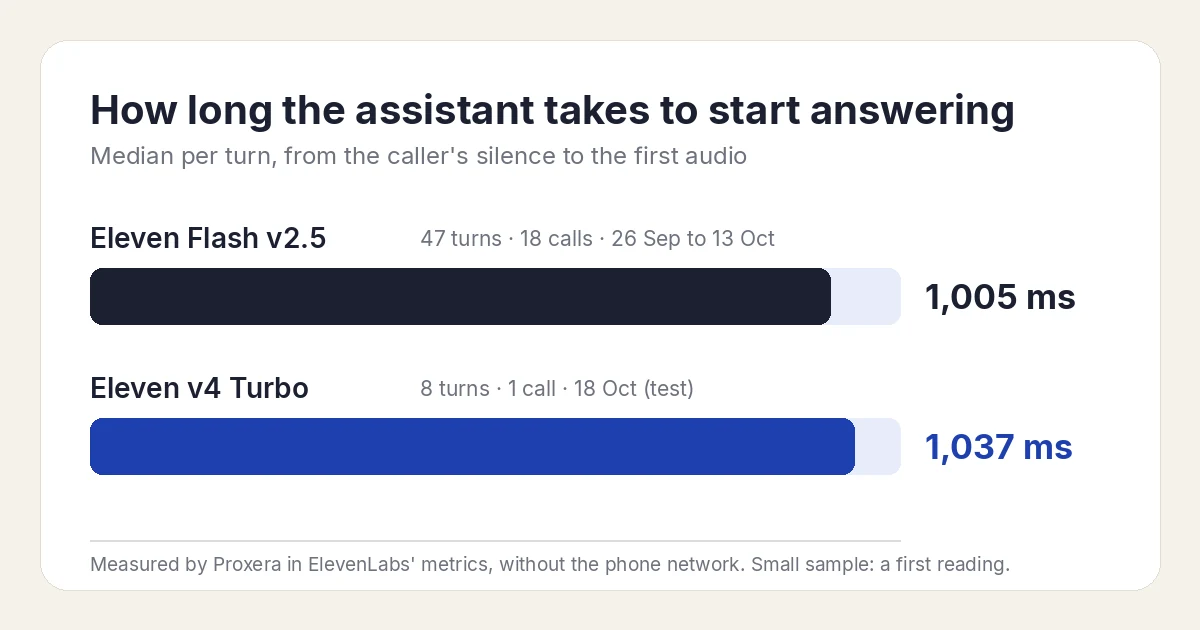
Eleven v4 Turbo is the text-to-speech model that ElevenLabs has released for agents that talk in real time, and since 18 October 2026 it is the one our voice assistant uses. According to ElevenLabs, it is more expressive than the previous ones and speaks more than 90 languages. In our test, the wait until the assistant starts answering was almost the same as with the previous model: a median of 1,037 ms against 1,005 ms, with a sample that is still small.
Until now our voice assistant for businesses spoke with Eleven Flash v2.5, another ElevenLabs model designed for real time. This article explains what the new one brings, what we measured before switching, what changes for callers and, along the way, which technology each Proxera channel runs on.
What Eleven v4 Turbo is, according to ElevenLabs
ElevenLabs presented the v4 family on 28 September 2026 in its announcement "Eleven v4: Our most expressive text-to-speech AI model yet", updated on 12 October. They are two models with different uses:
| Eleven v4 | Eleven v4 Turbo | |
|---|---|---|
| What ElevenLabs recommends it for | Voice-overs, audiobooks, characters | Conversational agents and interactive voice in real time |
| Latency it publishes | No figure given | Median inference of ~100 ms |
| Languages | More than 90 | More than 90 |
Source: ElevenLabs models documentation and Eleven v4 page, read on 18 October 2026.
For a business call, the one that counts is v4 Turbo. ElevenLabs describes it as its "most expressive" real-time speech synthesis model and recommends it, literally, for "support agents resolving customer queries in real time".
What it says improves, always according to ElevenLabs:
- The voice does not change mid-conversation. It uses a new method to capture the identity of each voice and says it keeps it "more reliably" across sentences, dialogue and narration.
- It follows instructions on how to say a sentence better, written in natural language or with tags, "more precisely than previous models". Its own page admits that those tags "are not perfect yet".
- The same voice can speak another language with a native accent and keep its timbre.
- More than 90 languages, Catalan among them.
What Eleven v4 Turbo is not: a faster model
There is an easy trap here. According to the same ElevenLabs documentation, the model we were using has an inference latency of ~75 ms, and v4 Turbo, of ~100 ms. Both figures carry the same note: they do not include application or network latency.
| Model | Model latency published by ElevenLabs | Languages |
|---|---|---|
| Eleven Flash v2.5 (the previous one) | ~75 ms | 32 |
| Eleven v4 Turbo (the current one) | ~100 ms | More than 90 |
In the announcement, ElevenLabs does present v4 Turbo as the fastest, but against four other providers (Cartesia, xAI, Google and OpenAI), not against its own models: a median of ~150 ms until the voice is heard, measured by them in September 2026, over WebSocket and without counting the network. The figures are 100 ms and 150 ms because they measure different things: one is how long the model takes, the other how long it takes to be heard.
So what v4 Turbo promises is not speed. It is naturalness and languages, while still being real-time. If that costs a few tens of milliseconds, we had to see whether it shows in a call. And no spec sheet says that: it has to be measured.
What we measured before switching
We do not change the model of an assistant that already answers calls just because a new one has come out. First we set up a test agent, a copy of the production one: same script, same rules, the same model deciding the answers and the same turn-taking and speech recognition settings, with its own number and without answering anyone from outside.
For each conversation, ElevenLabs stores per-turn metrics. The one we look at is the time from when the caller stops talking until the assistant's first audio comes out, inside the platform and without counting the phone network.
| Eleven Flash v2.5 (production) | Eleven v4 Turbo (test) | |
|---|---|---|
| Median wait per turn | 1,005 ms | 1,037 ms |
| Turns measured | 47 | 8 |
| Calls | 18 | 1 |
| Dates | 26 Sep to 13 Oct 2026 | 18 Oct 2026 |
| Voice | The production one | The same |
Source: per-turn metrics of the conversations in ElevenLabs, read by Proxera on 18 October 2026. Excluding the initial greeting.
If this is your case: What Xera does for your business (ES) →
The difference is 32 ms, and it has to be read carefully: on the v4 Turbo side there are only 8 turns from one call, so it is a first reading, not a conclusion. That same day we made two other test calls in which we changed voice and language mid-conversation, to try Catalan and the new voices; in them the wait was longer (medians of 1,593 ms and 1,912 ms), but we do not compare them with production because two things changed at once. We will keep measuring with real calls and, if the wait gets noticeably worse, we will say so here.
What changes for callers
- The voice. The assistant speaks with Eleven v4 Turbo. It is the same script and the same way of answering; what changes is the model that provides the voice.
- New voices. We have added two Spanish voices, Pablo and Alejandra, bringing the total to six. For Catalan, two more: Martina and Bernat.
- Catalan. If you need it, the assistant also answers in Catalan, at no extra cost. Flash v2.5 did not support it as the agent's language and v4 Turbo does. The other languages of each plan are on the voice assistant page.
Try it live: call +34 930 34 78 22 and speak to it in Spanish, Catalan, English, French or German
The assistant greets you in Spanish and carries on in your language when you reply.
Which technology Proxera runs on
We are often asked, and it is fair to say it with names. This is what each provider does in each channel, checked in our configuration on 18 October 2026:
| Channel | Provider | What it actually does |
|---|---|---|
| Voice assistant (phone) | ElevenLabs | Recognises what the caller says, runs the conversation and provides the voice (Eleven v4 Turbo). The language model that decides what to answer is Qwen3.5, from Alibaba, which we chose inside the ElevenLabs platform: for voice we use neither OpenAI nor Claude. Calls come in through a Barcelona number from Twilio. |
| Website chat and WhatsApp | OpenAI | Writes the chat assistant's replies, with the GPT-5 mini model. WhatsApp goes through Meta's official WhatsApp Business API. |
| XERA, the platform | Claude (Anthropic) | In XERA, each client uses Claude with their own subscription, taken out in their name. And we work with Claude internally to prepare, review and program. Claude does not answer your clients on the phone or in the chat. |
| Servers | Hetzner | The servers on which the website, the panel, the chat and the voice assistant service run are in Hetzner data centres in Finland. |
What makes the assistant answer like your business is built by us: its instructions, the message, the alerts, the panel and the call filter. None of these providers is a partner or sponsor of Proxera: they are services we pay for. The full list of providers that process data, and their safeguards, is in our privacy policy (ES).
What does not change for those who already have the assistant
- Your usual number. You keep diverting calls to your Xera number in Barcelona, as we explain in how to divert calls with Movistar, Vodafone or Orange.
- The message. When the call ends you receive the email with the summary, and your voice panel keeps the audio, the transcript and the message.
- The notices. The assistant introduces itself as an AI at the start and, if you have it switched on, warns that the call is recorded and transcribed.
- Prices. A model change does not touch the plans. If you are comparing, you have them in how much an AI virtual receptionist costs in Spain.
Try it
The quickest way to know how it sounds is to call it: +34 930 34 78 22. Proxera's assistant answers, and you can speak to it as one of your clients would, in Spanish, Catalan, English, French or German, or ask it whether it would work for your business. If you would rather speak with someone from our team, book a call (ES) and we will call you; that call is in Spanish. Appointments are booked in Spanish.
AI in action
Want to see XERA in action?
Talk directly to XERA and find out how it can automate the repetitive tasks in your business.
No commitment
Prefer it with a fixed day and time?
Book a video call (in Spanish)Pick a slot and the invitation reaches you straight away. The booking page is in Spanish.
Related content
Automate Your Accounting Firm in 2026: A Practical Guide for Professional Practices
A practical guide to automating your accounting and tax advisory firm or professional practice in 2026. What to automate, where to start and how XERA can help without changing your tax software.
2026 Personal Income Tax (IRPF) Checklist for Accounting Firms: Calendar, Documentation and Errors That Cost Penalties
A 2026 IRPF checklist for accounting firms: the tasks before, during and after the campaign. Avoid the chaos of April to June.