Platforms to connect real estate agents in Spain: what they are and what they do not solve
If you are searching for a "platform to connect real estate agents in Spain" you are probably looking at collaboration networks between agencies: systems where several agencies share portfolios, split the commission on a sale or rental closed jointly, and have access to more demand than they have on their own. In the sector they are also known as MLS (multiple listing service), although in Spain several models coexist under that name and others.
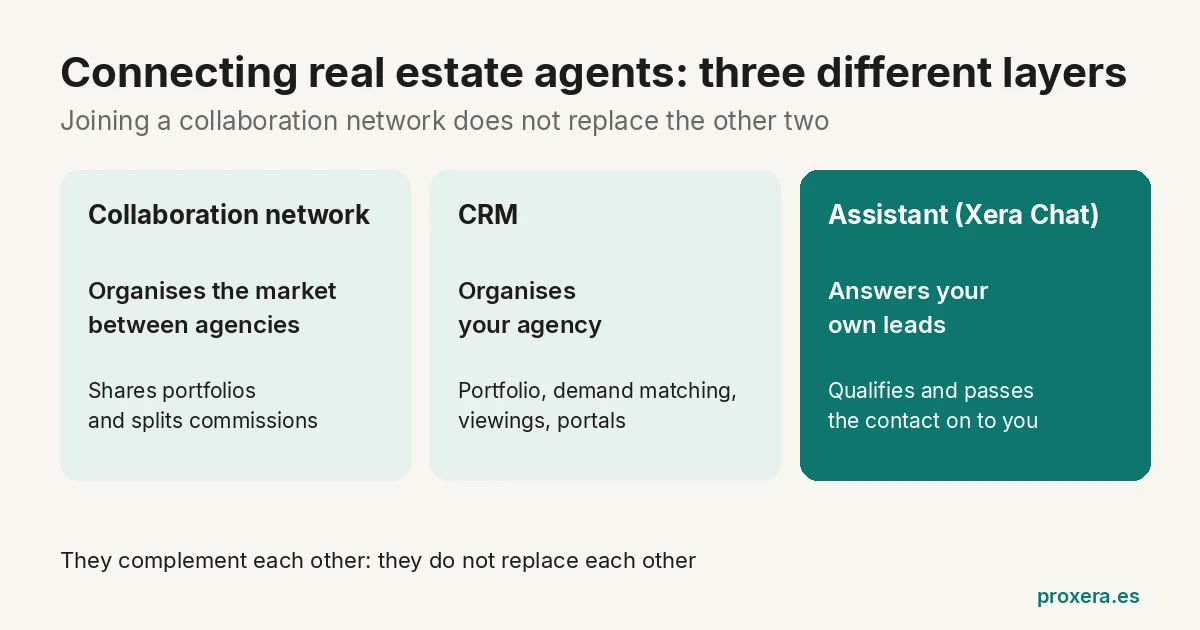
This article is not a comparison of those platforms —we do not have verified data on the prices or conditions of each one to put here—. It is a guide to what they are, what they are really for and, above all, what they do NOT solve: joining a collaboration network does not free you from the part a CRM does or from the part an enquiry-handling assistant does. They are three different layers.
What a collaboration network between agents is
The idea is simple: an agency uploads a property on an exclusive basis to the network, and any other member agency can offer it to its own demand. If it closes the deal, the commission is split according to the network's agreement (usually between whoever listed the property and whoever brought the buyer). The benefit for a small agency is entering a market of buyers much larger than its own contact list, without having to generate every demand itself.
What tends to vary from one network to another, and what is worth looking at before signing anything:
- How the commission is split and within what period the part that is not yours is paid.
- What exclusivity it requires. Some ask you to upload your whole portfolio there on an exclusive basis; others allow you to share only what you want.
- Real geographic reach. A national network is not equally useful if your market is a neighbourhood or a specific county: what matters is how many active agencies there are near you, not how many there are in the country.
- What happens if two agencies in the network offer the same flat to different buyers, and how the conflict over who "brought" the client first is resolved.
- What tools the agents use to communicate with each other inside the platform: whether it is a simple listing or includes messaging, notifications of interest and follow-up of the status of each shared deal.
Each network has its own conditions and we are not going to quote split figures or names of specific platforms without verifying them: if you are considering one, ask for the conditions in writing before uploading your portfolio.
What a collaboration network does not do for you
This is the point that is usually overlooked, and it is the reason it is worth separating from the rest: a platform connecting agents organises the market between agencies, not your agency's relationship with its own leads.
Sharing a property on a network does not change any of this:
- Who replies to the prospect who writes on a Sunday afternoon asking about a flat.
- Whether that contact is qualified (budget, area, timeframe) before an agent spends time on them.
- Whether the viewing is booked without overlapping another one, and whether a note is left of what the buyer said after seeing it.
- Whether the owner receives news of the process or has to call to find out.
Those four things are the job of your CRM and of how you handle WhatsApp or phone enquiries, not of the collaboration network. If your agency joins a network and multiplies the number of prospects it receives, and the attention and qualification part remains manual, all you have achieved is to move the bottleneck one step further on: now there are more leads and they are still not attended in time.
We have already written about those two pieces separately, because they are different problems and are solved differently:
- What an agency CRM really has to do (portfolio, demand matching, viewing calendar, portals): real estate management CRM.
- How to handle incoming leads on WhatsApp without losing those that arrive outside office hours: WhatsApp chatbots for real estate agencies.
- If you are also comparing management software with published prices: CRMs for real estate agencies in Spain.
Where Xera Chat fits in this picture
Xera Chat is not a collaboration network between agencies: it is an assistant that answers, on your own agency's channels such as your website, the prospects who write to you, whether they come from your own portfolio or from a property shared with you through a network (WhatsApp needs the official WhatsApp integration (Meta), on the Conecta plan). It qualifies, can arrange a viewing according to your availability if it is connected to your calendar (if it has an API, we connect it), and passes the contact to the agent with context when they add value.
Put another way: the network brings you more demand and splits the commission between agencies; Xera Chat is designed so that, when that demand writes to you, it gets a reply. They are layers that complement each other, not replace each other. If you want to see how it would fit your agency, write to us and we will show you on your case, or see XERA for real estate agencies. Calls and demos are held in Spanish.
AI in action
Want to see XERA in action?
Talk directly to XERA and find out how it can automate the repetitive tasks in your business.
No commitment
Prefer it with a fixed day and time?
Book a video call (in Spanish)Pick a slot and the invitation reaches you straight away. The booking page is in Spanish.
Related content
Automate Your Accounting Firm in 2026: A Practical Guide for Professional Practices
A practical guide to automating your accounting and tax advisory firm or professional practice in 2026. What to automate, where to start and how XERA can help without changing your tax software.
2026 Personal Income Tax (IRPF) Checklist for Accounting Firms: Calendar, Documentation and Errors That Cost Penalties
A 2026 IRPF checklist for accounting firms: the tasks before, during and after the campaign. Avoid the chaos of April to June.